

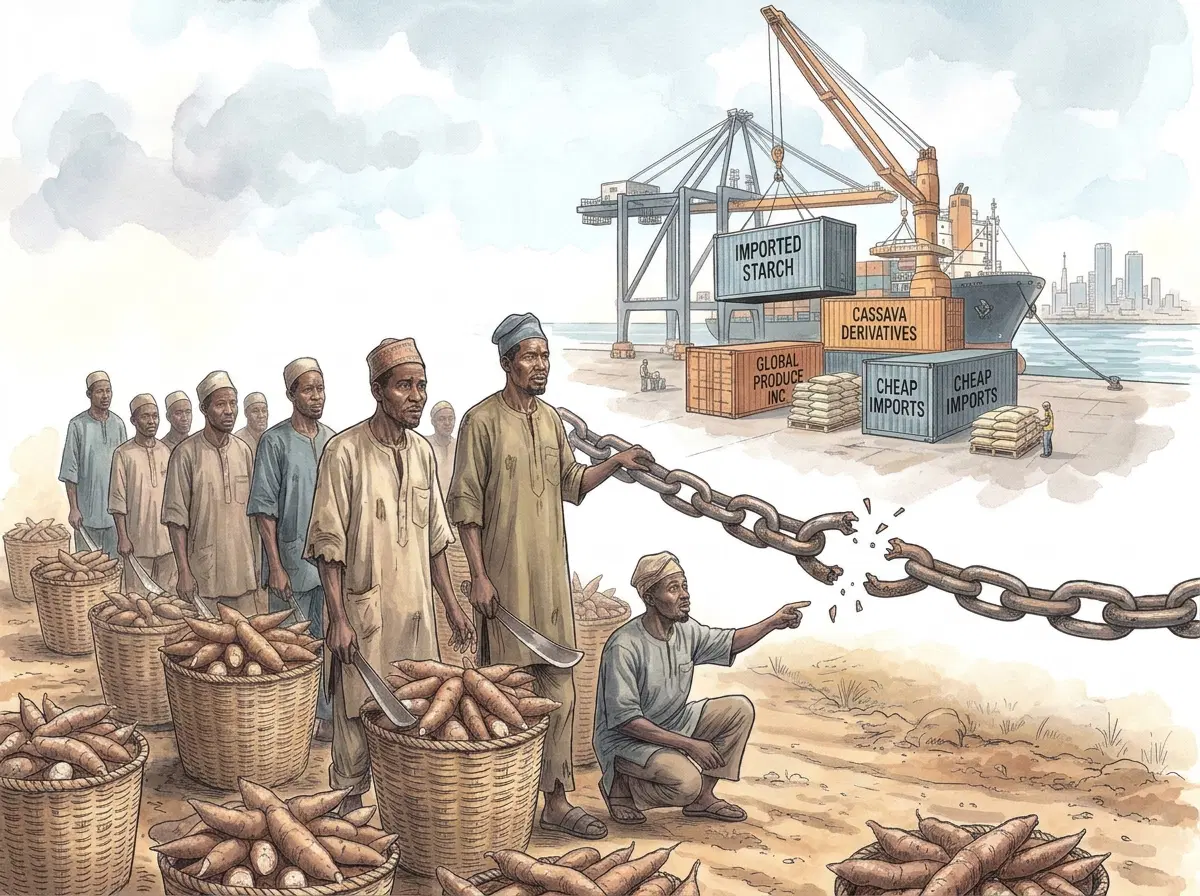
Nigeria’s cassava industry is facing growing pressure as rising starch imports threaten local processors, reduce farmers’ earnings and leave factories operating far below capacity. Industry stakeholders warn that high production costs, weak demand and unfavourable policies are putting local investments and farmers’ livelihoods at risk.
Cassava Starch Imports Surge
Nigeria’s cassava starch imports jumped from about 24.1 tonnes in 2020 to 3,227.7 tonnes in 2025, more than 130 times higher. Import spending also rose from $69,440 to approximately $2.16 million.
Data from the World Bank’s WITS database show that Thailand supplied the largest share, followed by countries including Turkey, China and India.
Farmers and Factories Struggle
The growing reliance on imported starch is hurting local producers.
Mrs Oluyemisi Iranloye, President of the Large-Scale Starch and Derivatives Producers Association of Nigeria, said farmers could spend about ₦800,000 cultivating one hectare of cassava but earn only around ₦300,000 from sales.
She also disclosed that some processing factories were operating at just 15 per cent of their capacity because of weak demand.
Kolawole Adeniji, Managing Director of Niji Group, blamed rising machinery costs, diesel prices, transportation expenses, insecurity and poor market prices for forcing farmers to reduce their farm sizes.
He called for long-term agricultural financing that gives farmers and processors enough time to recover their investments.
Import Policies Raise Concerns
In the Cassava Industry, local manufacturers say cheaper imported starch is making competition increasingly difficult, particularly as domestic producers struggle with high operating costs.
Iranloye also raised concerns about pharmaceutical-grade starch imports, alleging that some importers bring in excess quantities that eventually enter the wider local market.
The Federal Government introduced an Executive Order on Increasing Local Production of Healthcare Products in 2024, with incentives for eligible pharmaceutical manufacturing inputs. The Nigeria Customs Service later issued implementation guidelines.
However, local processors want policies that also protect the competitiveness of Nigerian manufacturers.
Nigeria’s Huge Cassava Potential Remains Untapped
Nigeria produces more than 60 million tonnes of cassava annually, making it the world’s largest producer. Yet much of the crop is consumed as food rather than processed into industrial products.
Segun Ladele, President of the Industrial Cassava Stakeholders Association of Nigeria, estimates that about 80 per cent of cassava goes into food consumption, while only five per cent serves industrial purposes. The remaining 15 per cent is exported.
The Food and Agriculture Organization identifies opportunities to expand cassava processing and improve the sector.
What Can Revive the Industry?
In the industry, stakeholders are calling for affordable financing, improved mechanisation, lower transportation costs, reliable electricity and stronger links between farmers and processing companies.
They also want consistent government policies that encourage local production and make Nigerian starch more competitive.
Without urgent action, Nigeria risks allowing its enormous cassava production potential to coexist with struggling farmers, underused factories and increasing dependence on imported starch.
